

Font Size
CFO Message
Updated on 10 November, 2026
Advancing Management That Is Conscious of Capital Cost
Under our previous medium-term management plan, VISION 2025, we shifted our approach to management that is conscious of capital cost and stock price and worked to enhance both profitability and capital efficiency. As a result, in addition to profit growth, we were able to achieve a return on invested capital (ROIC) of approximately 10%, largely achieving our financial indicators set out in VISION 2025.
Meanwhile, despite our current ROIC exceeding capital cost, it still remains easily influenced by factors including the external environment, and moreover, we have not been able to secure a sustainably high equity spread. I recognize that a key management issue is how to create a structure that consistently exceeds capital cost under any circumstances.
Although our weighted average cost of capital (WACC) has declined compared with the previous fiscal year, to 5.64%, we have set our internal hurdle rate at 7%, exceeding WACC, to maintain discipline in our investment decisions. Accordingly, we will continue enhancing corporate value not only through improvements resulting in reduced capital costs but also through enhanced business profitability and capital efficiency.
Advancing ROIC Management — Key Initiatives and Challenges
Despite our progress in improving our Groupwide ROIC under VISION 2025, the issue we discovered was disparities in capital efficiency across businesses. While highly profitable businesses raised ROIC across the entire Company, there were also cases of businesses where ROIC remained low, meaning that we were not able to secure a sufficient equity spread overall.
To improve this issue, we redefined our business portfolio under our new medium-term management plan, VISION 2030. We aim to achieve such optimization by accelerating growth through investment in growth-driving businesses and structural reforms in businesses undergoing restructuring. To achieve these goals, we have revised our capital allocation.
Further, while an understanding of such decision-making based on ROIC is growing across the Company, we still must ensure that decisions regarding individual investments and assessments of existing businesses are consistently made based on capital cost. Going forward, we will further ensure that investment criteria, which are based on a comparison of expected returns and capital cost, function as effective management indicators.
Capital Allocation Strategies Aimed at Growth
Under VISION 2025, capital allocation was based on cash inflows from operating activities and asset sales. Using these funds, we strengthened our earnings base by executing growth investments as well as strategic investments such as new business investments, shareholder returns, and repayment of interest-bearing debt. In hindsight, with shareholder returns taking center stage, we were unable to execute as many M&A transactions and other growth investments as envisioned, which was somewhat regrettable from the perspective of building future growth drivers.
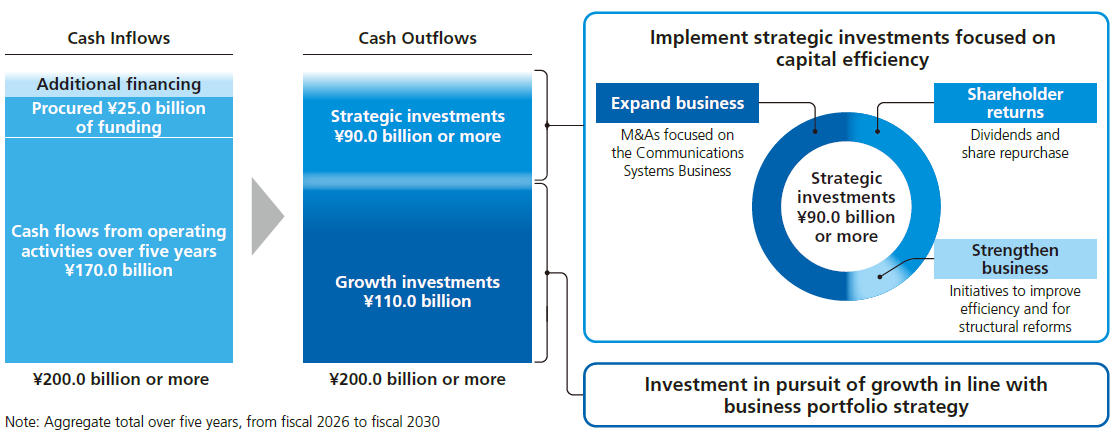
Under VISION 2030, we will proactively allocate ¥200 billion or more of capital, of which ¥110 billion will be earmarked for growth investments that form the foundation of earnings, and ¥90 billion or more allocated for strategic investments such as business expansion, strengthening of our business foundation, and shareholder returns. This will not only achieve our management indicators but also move us closer to our "aspirational targets." The cash inflows required to support these investments are expected to consist of ¥170 billion in operating cash flow and ¥25 billion from the proceeds of the convertible bonds with stock acquisition rights approved in November 2025, excluding the portion used for share repurchases. Any remaining funding requirements are expected to be met through additional financing.
Under VISION 2025, we pursued a balanced approach to investment and shareholder returns utilizing the cash generated by the business. However, reflecting on our inability to execute growth investments to the extent originally intended, under VISION 2030 we have shifted to a more proactive and flexible approach to capital allocation. We will actively deploy capital to support growth initiatives and structural reforms, while securing the funding required to do so, including through additional financing when appropriate.
At the same time, we will maintain strict investment discipline to avoid inefficient capital deployment. Our policy is to comprehensively evaluate each investment opportunity based on projected ROIC, payback period, and risk factors; establish clear priorities; and carefully select projects expected to enhance capital efficiency over the long term. In addition, we will continuously evaluate existing businesses, and where returns remain consistently below the cost of capital, we will pursue measures including structural reforms and reallocation of assets.
Financial Strategy Aimed at Realizing VISION 2030 and Dialogues with the Capital Market
We will deepen dialogues with the capital market by refining IR activities and sufficiently disclosing information, with the aim of enhancing the market's confidence in JVCKENWOOD's growth prospects and its ability to improve capital efficiency, through portfolio reforms and enhanced profitability. Another vital component of our financial strategy is the creation of an optimal capital structure. We aim to reduce WACC and enhance return on equity (ROE) while maintaining financial stability by appropriately controlling the balance between liabilities and equity.
Under VISION 2030, we aim to stabilize ROIC in the medium to long term at 10% or higher and maintain a sustainable ROIC spread. To realize this, we will pursue an integrated approach by promoting growth through investment, refining capital efficiency management, and reducing capital costs.
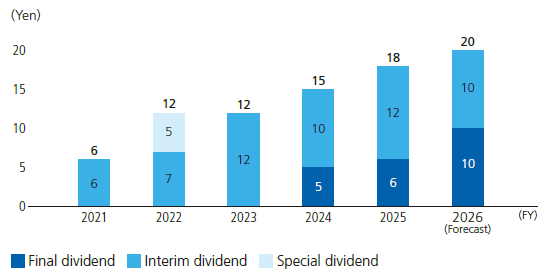
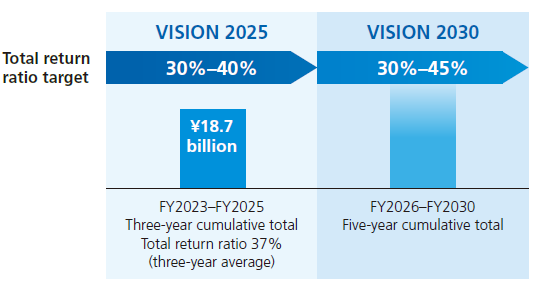
Regarding shareholder returns, we raised our upper limit by five percentage points above the conventional target for total return ratio, from 40% to 45%. While maintaining stable dividends and a track record of continuous dividend increases as our foundation, we will conduct proactive share repurchases and respond flexibly, taking into account the balance with growth investments and market conditions.
Going forward, as CFO, I will contribute to maximizing corporate value by enhancing the transparency and understanding of management through dialogues with the capital market.
Changes in Dividends per Share
Total Return Ratio and Total Amount of Shareholder Returns







IR Information (Policies & Resources)
- Creation of Value Through Connectivity
- Communication - - Visualization and Enhancement of Awareness
- Visual - - Sound Design that Appeals to the Senses
- Audio - - Underlying Technologies Supporting Our Strengths
- Monozukuri - - Integration Capabilities that Connect Technology and Sensitivity
- Design -
Our Brands






 Select Your Country