

Enterprise Risk Management
Key Philosophy and Activities
The JVCKENWOOD Group regards risks as factors that could inhibit the achievement of its business plans and works to minimize impact or damage by accurately identifying all risks associated with its business activities. We are establishing a system based on the belief that it is also important to take advantage of these risks, viewing them as opportunities to maximize returns.
With a director who supervises and promotes risk management from a company-wide perspective, and the Legal & Compliance Office serving as the secretariat, the heads of Business Sectors, Group companies, and the Administrative Division take the lead in proactively and regularly identifying risks the Company may face. These include short-, medium-, and long-term risks, including issues caused by climate change. Through this initiative, we understand risks in advance, consider rapid countermeasures in the event of their realization, and prepare to take action. Doing so enables us to manage risks and opportunities appropriately.
Risk Management System
The risks*1 in the business environment surrounding the JVCKENWOOD Group are increasingly diverse and complex, and the Group has established a risk management system to formulate and implement enterprise-wide risk mitigation measures. The Chief Executive Officer is directly responsible for this system.
In addition, in order to promote initiatives about climate change risks in line with the Task Force on Climate-Related Financial Disclosures (TCFD)'s recommendations, since FY2023 we have included categories for transition risks*2 and physical risks*3, which similarly to other risks have been subject to regular evaluations and progress monitoring. Please see below for the specific measures we are taking.
Responses to Climate Change
*1: In addition to exchange rate fluctuations, international taxation, geopolitical risks, emerging country risks, large-scale disasters, procurement, intellectual property lawsuits, etc., a wide range of risks are also covered such as human rights issues, information security and climate change, which have been increasingly recognized as risks in recent years.
*2: Risks arising from the transition to a low-carbon society
*3: Risks arising from physical changes due to climate change
The Group's risks management process operates on the cycle described below (see diagram).
1. We have established the Company-wide Risk Management Committee hosted by the Chief Executive Officer (CEO), chaired by the director in charge of risk management, and composed of directors and heads of administrative divisions designated by the chairman. Based on business risks faced by business sites and identified by each business unit and region, as well as management issues and business issues, we will formulate measures to resolve “global important risks that should be addressed with the highest priority” extracted in light of their impact on business, urgency, and degree of incident, and designate an officer in charge of managing the relevant risks as the officer responsible for promoting countermeasures as a company-wide measure at the management level.
2. The officer responsible for promoting countermeasures implements a cycle to deploy and improve measures against “global important risks” to business units and regions and monitors progress as business initiatives to be achieved during the current consolidated business year.
3.All the divisions in the Group implement annual risk surveillance to assess “business base risks” based on their impact on the business, frequency of occurrence, and status of response, and formulate and implement countermeasures. In addition, each division implements a cycle of monitoring and improving the progress of countermeasures.
In FY2024 and FY2025, as important risks, we again selected enhancement of strengthening security, and we newly selected compliance with laws and regulations and social demands and system operation. We also appointed an executive officer in charge as a responsible person. The Board of Directors also receives reports on the status of responses to the identified important risks, and these are appropriately managed and supervised.
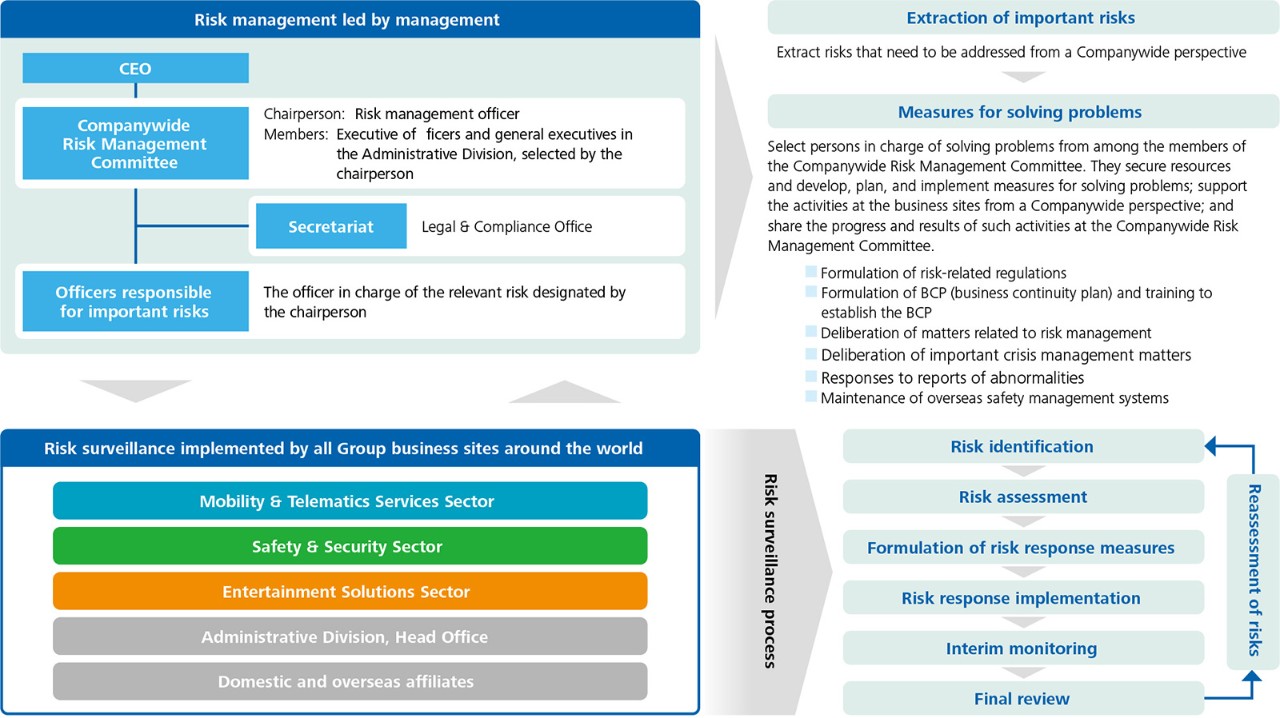
Image of risk management structure
Mapping by Risk Assessment and Countermeasures
Risks identified through risk surveillance are comprehensively evaluated and mapped at the Company-wide Risk Management Committee according to Impact, Urgency, and Response Level, and classified as follows.
Countermeasure risks: Risks to be avoided by developing a response implementation plan (see below table (1) to (12) )
Monitoring risks: Risks to be deterred or transferred
Recording risks: Risks to be retained
| Impact Example of losses |
× | Urgency | - | Response levels | |
|---|---|---|---|---|---|
| 5 | Significant More than ¥1 billion |
Very high Within 1 year |
Already taken measures | ||
| 4 | Serious More than ¥100 million |
High Within 3 years |
Mostly taken measures | ||
| 3 | Standard More than ¥10 million |
Medium Within 5 years |
Taken measures to a certain extant | ||
| 2 | Minor More than ¥1 million |
Low Within 10 years |
Taken some measures | ||
| 1 | Insignificant Less than ¥1 million |
Very low Beyond 10 years |
None measures taken |
| Countermeasure risks | ||||||
| Impact | 5 | Monitored risks | (9) | (1)(7)(8) | ||
|---|---|---|---|---|---|---|
| 4 | (12) | (3)(5)(6) | (2)(4) | |||
| 3 | (10)(11) | |||||
| 2 | Recorded risks | Monitored risks | ||||
| 1 | ||||||
| 1 | 2 | 3 | 4 | 5 | ||
| Urgency | ||||||
Among these, risks that have a high degree of impact and urgency for the Group are classified as countermeasure risks for which we must formulate response plans to avoid. In fiscal 2024, the Companywide Risk Management Committee identified a total of 12 countermeasure risks. Outside of countermeasure risks, we also manage monitored risks, which may be deterred or transferred, and recorded risks, which are retained despite having a minimal impact.
Global Important Risks for the Group
In FY2024 and FY2025, we identified risks to address as shown in the table below. At meetings of the Company-wide Risk Management Committee, we also selected global important risks from among the major risks to address that had been identified, based on management and business issues, and formulated countermeasures along with other risks to be addressed.
For global important risks ((1), (7), and (8) in the table below), we again selected strengthening of information security, and we newly selected compliance with laws and regulation and social demands and operation. We also appointed an executive officer in charge as a responsible person. The Board of Directors also receives reports on the status of responses to the identified important risks, and these are appropriately managed and supervised.
| Risk item | Impact | Urgency | Risk assessment | Countermeasures | ||
|---|---|---|---|---|---|---|
| Changes in the business environment | (1) | Compliance with laws, regulations, and social demands | 5 | 5 | Important | Respond to various regulations and laws enforced in each country through a cross-functional project system within the Company. Also promote the strengthening of the internal control system, which is the core of the Company's operations |
| (2) | Changes in supply chain management | 4 | 5 | Countermeasure | Prevent cost deterioration and suspension of activities at domestic and overseas production factories through measures such as securing development backup and multiple suppliers, holding BCP inventory, adopting general-purpose parts, and securing inventory through the use of intermediaries. These measures are incorporated into business management and daily management cycles | |
| (3) | Economic fluctuations and changes in preferences | 4 | 4 | Countermeasure | Monitor changes and take measures according to the scale of risk, ranging from daily operational measures to contingency plans | |
| (4) | Exchange rate fluctuation | 4 | 5 | Countermeasure | Implementation of hedging transactions such as exchange contracts | |
| (5) | Technological innovation | 4 | 4 | Countermeasure | Revise the technology development and commercialization road map in a timely manner, including changing market environments, social demands and technology trends, and the systematic development of engineering human resources and their skills | |
| (6) | Rapid evolution and transformation of the industry | 4 | 4 | Countermeasure | Promote development of proprietary products and services and establish a position not affected by industry changes | |
| Business operations | (7) | Information security | 5 | 5 | Important | Establish the JK-CIRT/CC under the control of the chief information security officer (CISO) to clarify the Company's security system in light of the government's request to strengthen cybersecurity measures. Strengthen the security system to protect the Group's information assets and information assets entrusted by customers around the world as well as stakeholders, including business partners, shareholders, and employees of the Group |
| (8) | System operation | 5 | 5 | Important | I Implement regular backups of data, in addition to creating high-level security countermeasures and redundant infrastructure for data centers and software as a service systems | |
| (9) | Quality problem | 5 | 4 | Countermeasure | Implement thorough checks to prevent quality problems by complying with the standards of each process with an emphasis on quality in the processes of planning, development, and production and establishing effective phase gates. Promote product safety assessments of new models, reinforcement of management of critical safety parts, reconstruction of the product safety management system (e.g., database of product liability information), design assessments for quality improvement and safety assurance, and sharing of know-how across the whole Company | |
| (10) | Loss and shortage of human resources | 3 | 4 | Countermeasure | Secure diverse human resources through expansion of recruitment of new graduates and diversified implementation of mid-career recruitment, facilitate career development by establishing the employee development system, and promote retention, appropriate age structure, and rebalancing of employees through synergies with workstyle reform | |
| (11) | Business alliance with others companies | 3 | 4 | Countermeasure | Fully analyze and examine the risks and potential synergies with the Group associated with business alliances | |
| Disasters, etc. | (12) | Natural disasters, pandemics, and man-made disasters | 4 | 3 | Countermeasure | Promote business continuity management, including business continuity and early recovery from disasters, by establishing various manuals for crisis response and implementing disaster prevention drills, BCP training, and safety confirmation drills in preparation for emergencies, as well as rapid resumption of production, shipment, and services |
* Product liability
Business Continuity Management (BCM)
Numerous risks confront our business, the risk of earthquake and other natural disasters, the spread of infectious diseases, and global expansion of terrorisms among the most pressing. In the face of these risks, JVCKENWOOD's first priority is to preserve human life, but it also bears a responsibility to its stakeholders to have systems in place that will enable it to continue to provide products and services. The Group has set forth the Business Continuity Management Rules and articulated basic policy for business continuity in its Business Continuity Plan (BCP), which serves as the foundation for its Business Continuity Management (BCM). BCP-related units work actively to refine the plan in a PDCA cycle, conducting BCP exercises in accordance with annual plans to identify issues and revising the BCP accordingly.
Basic policy on Business Continuity Plan (BCP)
Contribute to the security and safety of society through sustained business operations by promptly restoring business activities after an emergency occurs.
At the JVCKENWOOD Group, for example, we have envisioned risks such as the following and formulated BCPs accordingly.
| Natural Disasters | For natural disasters, we have formulated a BCP that envisions the occurrence of a major earthquake, resulting in multiple business offices in Japan being affected at the same time. In accordance with related rules and manuals, we have set forth rules on the establishment of disaster and accident taskforces at our head office, response in the event of disaster, and other matters. Additionally, we conduct hands-on exercises in regions that we expect to be affected, and revise rules and the BCP based on any issues identified from the exercises. In this way, we continuously strengthen our preparations for disasters. |
|---|---|
| Infectious Diseases | For infectious diseases, we have formulated a BCP that envisions that occurrence of pandemics related to all forms of infectious disease, typically influenza, COVID-19, etc., and have summarized the measures employees, visitors, etc., should take at each business site in the event of the spread of an infectious disease. To ensure safety and security, we have also updated our infection control manuals and other existing materials, and taken measures to prevent the spread of various forms of disease based on such materials. We have utilized the lessons learned from the spread of COVID-19 since 2020 to revise various manuals and our BCP. In this way, we have developed a crisis management system to ensure an accurate and prompt response, both in normal circumstances prior to the outbreak of infection, and after infection occurs. |
| Business activities at overseas sites | The JVCKENWOOD Group has multiple business sites overseas, and we have therefore formulated BCPs that envision the occurrence of various incidents and emergencies, such as acts of terrorism, public disturbance, and conflict. Additionally, we have developed manuals, etc., to protect the safety of people overseas, and our head office Human Resources Department and departments responsible for risk management hold regular joint desktop evacuation exercises with local production centers and sales companies. We also revise manuals, etc., in accordance with issues identified from exercises, thereby continuously strengthening our preparations for the occurrence of incidents. In response to the Russia-Ukraine crisis, which actually occurred, we were able to evacuate personnel outside the country at an early stage without any issues. |
Certification as a Business Operator Contributing to the Building of National Resilience Against Disasters (Resilience Certification)
In March 2017, JVCKENWOOD received certification from the Association for Resilience Japan based on the guideline issued by the National Resilience Promotion Office, Cabinet Secretariat, as a business operator contributing to the building of national resilience against disasters (Resilience Certification) in recognition of its endorsement of the objective of promoting the building of national resilience and active engagement in efforts related to business continuity. As a result of ongoing activities of disaster prevention and mitigation and business continuity plans (BCPs), we passed the renewal examination for our Fourth Resilience Certification on March 31, 2025. JVCKENWOOD will continue to work to further enhance the quality of BCM in the future.
Certification as Organization Contributing to National Resilience (Resilience Certification)
Registration Certificate (obtained on March 31, 2017, updated on March 31, 2025)


