

Responses to Climate Change
Basic Policy
The issue of climate change is becoming more and more severe each year, and it has the potential to cause serious impacts across a wide range of fields, including people's lives and economic activities. Addressing the issue of climate change is a key management issue, and the JVCKENWOOD Group is advancing initiatives to avoid or reduce the impact of climate change on the Group throughout its entire value chain, including procurement, product development, manufacturing, and product and service provision. At the same time, we aim to contribute to the response to climate change, which is a pressing issue for international society.
To this end, initiatives to contribute to the mitigation of and adaptation to climate change are important. The JVCKENWOOD Group will endeavor to reduce CO2 emissions in the Scope 1+2 and Scope 3 categories and to reduce energy use through reduction of production man-hours and installation of energy-saving equipment.
We have set targets for CO2 emissions in the Scope 1+2 and Scope 3 categories which are consistent with the 1.5ºC limit of the Paris Agreement*. We are making steady progress toward our targets, and will continue to focus on climate change-related initiatives.
In the JVCKENWOOD Group, the Sustainability Management Office takes the lead in ongoingly deepening discussions around setting targets and collecting related information, including that about science-based targets (SBT). Looking ahead, by continuing to advance initiatives as appropriate - starting from feasible measures - through actions such as setting appropriate targets, management, and information disclosure, we will revise strategies and targets to suit changes in environmental conditions and the introduction of new technology.
* A multilateral international agreement adopted at the United Nations Climate Change Conference (COP 21) held in Paris through December 12, 2015 aimed at climate change measures from 2020 onwards. This agreement aims to limit the average global temperature increase to 2ºC from pre-Industrial Revolution levels, and furthermore incorporates a direction of pursuing efforts to restrict the increase to within 1.5ºC.
The JVC Kenwood Group has set a short-term mid- to long-term global carbon reduction target as follows.
■Reduction of CO₂ emissions generated from business activities
Responses to climate change: Achieve carbon neutrality by 2050
Scopes 1 + 2 Target:46.2% reduction from FY2019 levels by FY2030 (total, global)
In promoting our initiatives, we set the following KPI (Key Performance Indicators) and manage their progress.
| Theme | Plan/Achievement | KPI | |||
|---|---|---|---|---|---|
| FY2023 | FY2024 | FY2025 | FY2030 | ||
| Reduction of CO2 emissions (Scope 1 + 2) (compared to FY2019) | Plan | -16.8% | -21.0% | -25.2% | -46.2% |
| Achievement | -41.0% | -46.5% | |||
■Reduction of CO₂ emissions through the use of purchased, transported, and sold products
Scope 3 target: 13.5% reduction from FY2019 levels by FY2030 (Categories 1, 4, 11*, global)
*Category 1: Emissions associated with raw materials, parts, and purchased products; Category 4: Emissions associated with transportation of raw materials and products; Category 11: Emissions associated with assumed electric power consumption for the use of products sold
In promoting our initiatives, we set the following KPI (Key Performance Indicators) and manage their progress.
| Theme | Plan/Achievement | KPI | |||
|---|---|---|---|---|---|
| FY2023 | FY2024 | FY2025 | FY2030 | ||
| Reduction of CO2 emissions (Scope 3) (Categories 1, 4, 11) (compared to FY2019) | Plan | -4.91% | -6.14% | -7.36% | -13.50% |
| Achievement | -8.44% | -19.04% | |||
As part of our initiatives aimed at achieving this target, we have been monitoring power consumption at business centers, upgrading production/air-conditioning equipment to high-efficiency models, introducing LED lighting, and promoting environmental education among employees. As a member of the Japan Electronics and Information Technology Industries Association (JEITA), we have been collaborating and gathering information on not only reducing total CO₂ emissions but also improv energy intensity. In 2019 we participated in the Ministry of the Environment’s program designed to support companies that use internal carbon pricing and started efforts to raise in-house awareness about the environmental cost of carbon (for details, see the website of the Ministry of the Environment ). Going forward, with the aim of participating in the "GX League*" sponsored by the Ministry of Economy, Trade and Industry. we will consider emissions trading, formation of market rules, creation of business opportunities, and exchanges with participating companies to achieve emissions reductions and increase industrial competitiveness.
*GX League: A league of companies with leadership in providing value for social structural change towards carbon neutrality, including voluntary greenhouse gas emission trading (GX-ETS).
Disclosure Based on TCFD Recommendations
In April 2023, the Group expressed its endorsement of the recommendations of the Task Force on Climate-related Financial Disclosures (TCFD) established by the Financial Stability Board (FSB).
For details, see the website of Task Force on Climate-related Financial Disclosures

■Governance
The JVCKENWOOD Group recognizes that addressing climate change is one of the important issues in its sustainability promotion strategy. The Company appointed a director in charge of sustainability under the supervision of the Board of Directors, and established the Sustainability Management Office in April 2018 to establish a system for quickly implementing sustainability promotion strategies including those related to climate change.
The Sustainability Management Office is responsible for coordinating the implementation of company-wide climate change initiatives and progress management. It works with relevant divisions to periodically review material issues and key performance indicators (KPI), study and collect information about the potential effects of climate change on our operations, and enhance the disclosure of sustainability-related information.
In addition, the Sustainability Management Office actively communicates with relevant departments and sections and takes the lead in efforts to make sustainability part of our business operations, all with an eye to fostering awareness and understanding of climate change issues within the Group.
In addition, as a governance structure to address climate change, the Sustainability Committee was established that reports directly to the CEO in FY2023 as the primary organization to promote overall sustainability, including addressing climate change. It will formulate strategies and study measures for decarbonization.
Augmenting regular meetings twice a year, the Committee holds ad hoc meetings as necessary, and reports its discussions to the Executive Committee and the Board of Directors.
In addition, as a sub-organization of the Sustainability Committee, we have established a specialized subcommittee with the executive officer in charge of each theme (Regarding climate change, the Environment Subcommittee) to discuss and promote the identification of issues, goals, implementation plans, and specific responses for each theme.
These initiatives are overseen by the Board of Directors. Based on its regulations, the Board receives reports from the Sustainability Committee as required, and also manages the progress of these initiatives. It does so through means such as drawing up and approving environment-related business strategies and annual budget plans, as well as making approvals related to information disclosure and drawing up climate transition plans concerning dependency, impacts/risks, and opportunities.
JVCKENWOOD is working to build a Board structure which enables highly-effective oversight of initiatives regarding ESG issues. As well as having members with executive-level experience concerning ESG issues, we are working to increase Board members' capability levels through methods such as regularly holding training about environmental issues and external frameworks (such as TCFD) and lectures and panel discussions by external specialists (the Sustainability Symposium).
Sustainability Promotion Structure
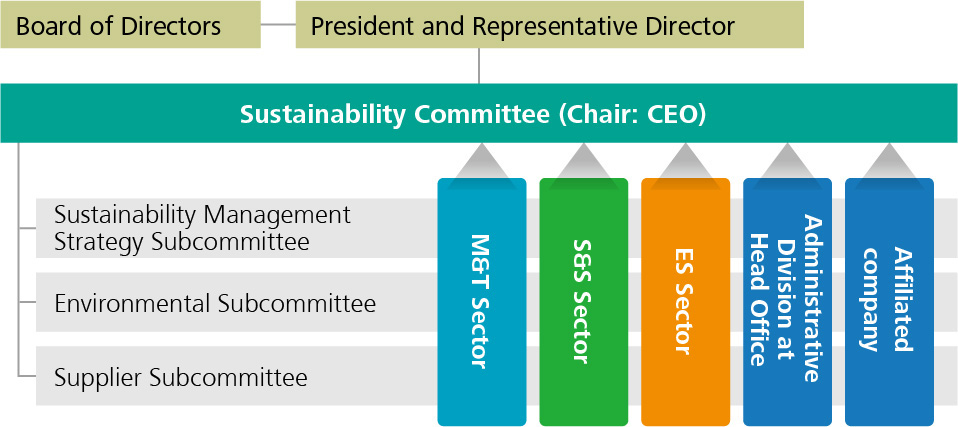
As specific activities for FY2023, the Environment Subcommittee discussed the setting of targets under our basic environmental policy "JK Green 2030" - which mainly focuses on response to climate change, effective use of resources, environmental conservation and management, and conservation of biodiversity - and these were approved by a resolution of the Board of Directors.
Activities for FY2024 included reports made at the Environment Subcommittee about third-party evaluation results and CO2 emissions inventory revisions.
In addition, at the Supplier Subcommittee held at the same time, reports and discussions were held regarding efforts to improve the accuracy of emissions calculations and to reduce emissions, especially for Category 1: Purchased goods and services, and Category 4: Upstream transportation and distribution under Scope 3.
Additionally, in the FY2025 compensation review, ESG indicators (engagement, CO2 emissions reduction, and external assessment) were added to the short-term incentive (STI) KPI performance evaluations for Directors (including Representative Directors of the Board) who are not members of the Audit and Supervisory Committee.
Please see Corporate Governance for details.
■Strategies
Since FY2023, JVCKENWOOD Group has regularly conducted scenario analyses in a form consistent with the TCFD final recommendations. By doing so, we have broadly identified the impacts on our business model of risks and opportunities (as well as dependency on and impacts from nature), and we are taking initiatives to further increase the accuracy of our analysis. Additionally, regarding the financial impact from our climate transition plans, we are working to evaluate the targets and outcomes of the cost effectiveness of greater energy efficiency etc. derived from, in particular, the consolidation and closure of production bases.
The risks and opportunities identified in the scenario analyses had an impact on the following upstream and downstream aspects of the value chain in particular: 1. raw material procurement, 2. the production process, and 3. transport and logistics. In our strategies, we identified that impacts were possible on the likes of 1. product development and design, 2. laws and regulations as well as compliance with them, and 3. changes in customer and consumer behavior.
In addition to working on creating more products which contribute to decarbonization as well as countermeasures such as cost savings through energy and resource savings, we have also been working on opportunities to contribute to further growth.
Identification of risks and opportunities in the JVCKENWOOD Group and impact on the business
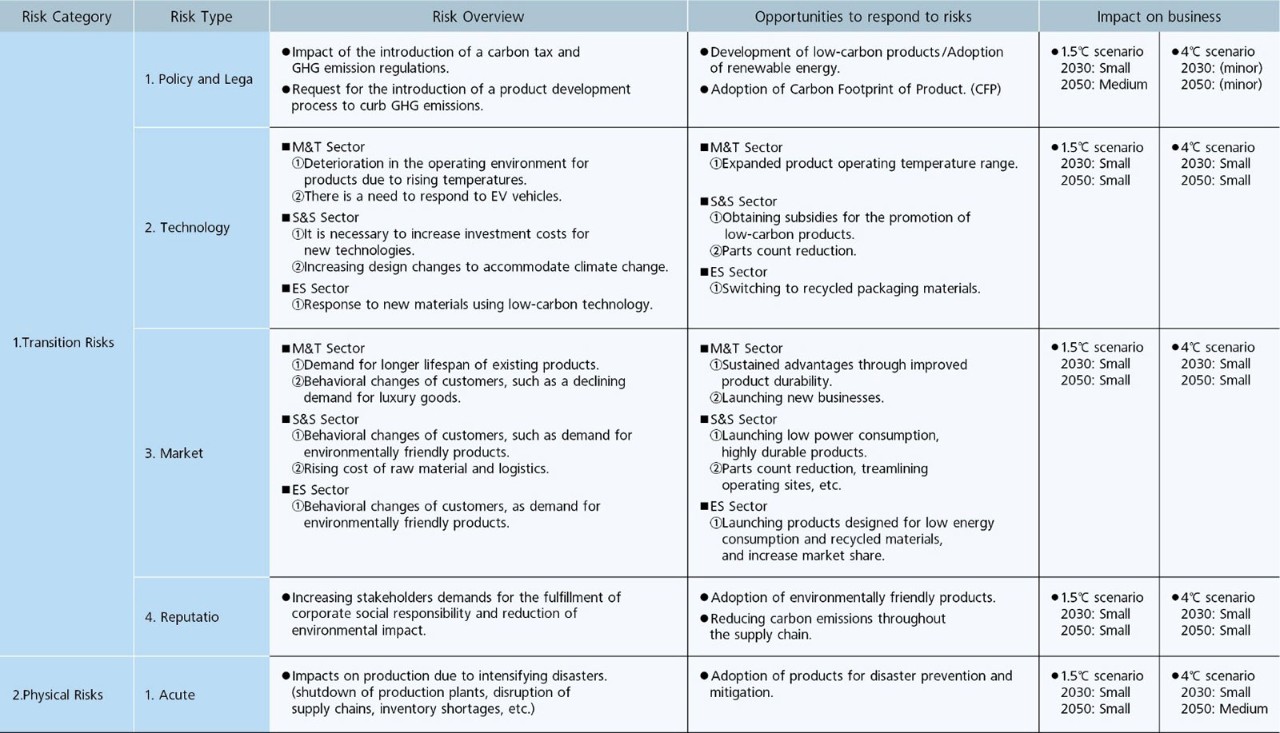
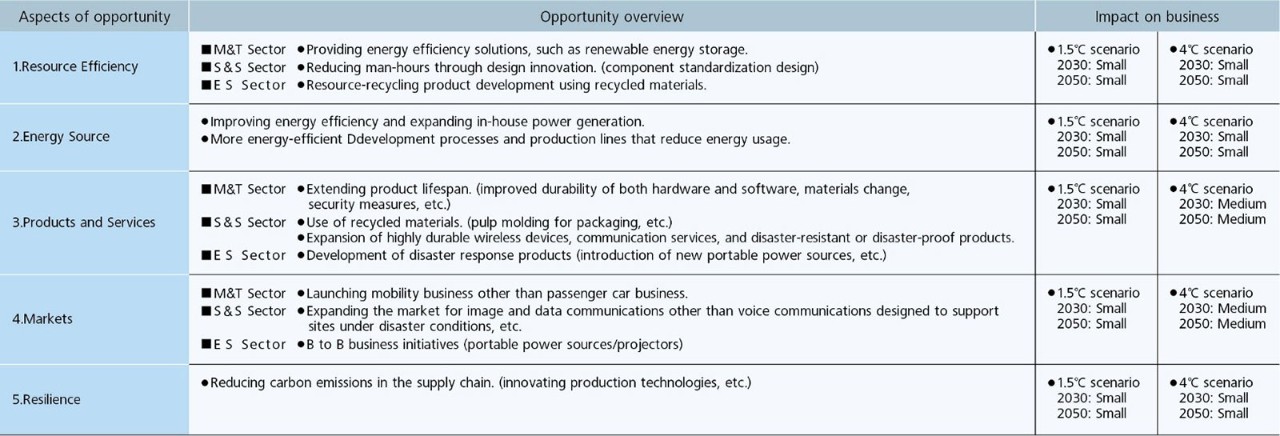
As a countermeasure to the risks and opportunities identified, we will develop and introduce environmentally friendly products and products for disaster prevention and mitigation, and work to develop new markets.
In addition, in conjunction with the new medium-term management plan VISION2025, we will return to domestic production in products for the Japanese domestic market, optimize the layout of production bases in consideration of total production volume, develop products with reduced environmental impact, study alternatives to natural resource facilities, and plan investments in measures such as the use of energy power. Furthermore, through initiatives such as the usage of Sustainability-Linked Loans, we will respond to various risks and increase our resilience to climate change by reducing energy consumption and CO2 emissions as well as improving the efficiency of processes in manufacturing, transportation, and other corporate activities.
Initiatives toward the optimization of manufacturing via the Production Grand Design - which includes a return to domestic production - are making progress. These include the closure and integration of production bases and business centers and the consequent increased production volume at JVCKENWOOD Nagano, which have led to reduced CO2 emissions.
Regarding resource management, as part of our work on measures against climate change, analysis of recycling, resource depletion, and supply shortages has enabled us to strengthen measures regarding risks and opportunities such as formulating strategies for sustainable resource management.
Progress in CO2 reduction plans through the Production Grand Design optimization of production and development bases
1) Production and development bases consolidation and closure plan which leads to energy saving
| FY2022 | Transfer of car navigation system production (from Indonesia to Nagano)/Transfer of projector production (from Thailand to Yokosuka) Transfer of professional camera production (from Thailand JKET to Thailand JKOT) and termination of production activities at JKET Transfer of car navigation system production for domestic OEMs (from Shanghai, China to Nagano) |
| FY2023 | Transfer of M&T development functions from Singapore and closure of development base in Singapore Termination of production activity at the Shanghai, China production base |
| FY2024 | Closure of the Hachioji and Kurihama business centers, concentration from the Hakusan Business Center to Head Office |
2) Emissions reductions from the consolidation and closure of production and development bases in and before FY2024
| FY2022 | 2,700t of CO2 emissions reduced compared to a target of 1,700t |
| FY2023 | 9,000t of CO2 emissions reduced compared to a target of 1,800t |
| FY2024 | 2,200t of CO2 emissions reduced compared to a target of 1,800t |
Coverage: Refer to "CO2 Emissions by Business Center" on the CO2 emissions reduction page
Regarding resource management, as part of our work on measures against climate change, analysis of recycling, resource depletion, and supply shortages has enabled us to strengthen measures regarding risks and opportunities such as formulating strategies for sustainable resource management.
(Reference materials: "Recommendations for Creating Management Strategies Utilizing Sustainability (Climate and Nature Related) Information Disclosure: Practical Guide for Incorporating TCFD Scenario Analysis and Nature-Related Risks and Opportunities in Business Management," version 2.0, Ministry of the Environment, Japan, March 2025
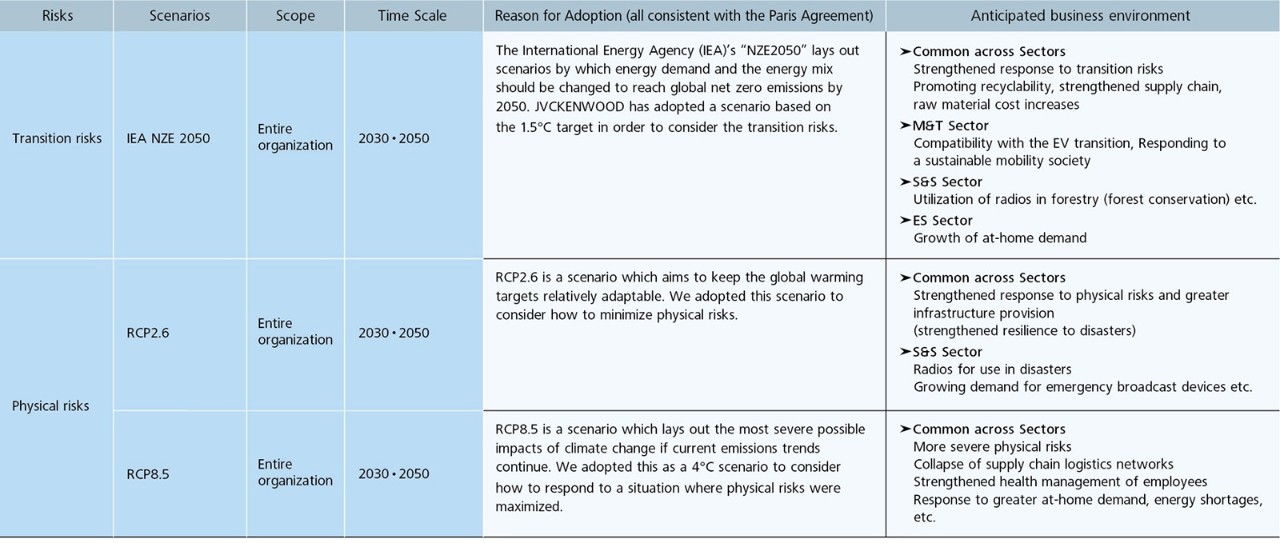
Scenario analysis takes into account many aspects of the external environment, such as technological, economic, and social factors. These include development and uptake speed of new technology, international cooperation structures, feasibility of policies, global economic growth rates, and changes in energy demand. However, the data used is current at the time the scenario analysis is carried out, and while care is given to improving accuracy of the analysis, the impact on our business of the identified risks and opportunities inevitably contains elements of uncertainty.
■Risk Management
We implement the risk surveillance process at all its business sites around the world every year. The purpose is to ensure the risk management activities are conducted through collaboration between its business sites and management. As the risk items for the risk surveillance process include natural disasters, we also identify, assess and manage climate change risks. For details of the risk surveillance process, see Enterprise Risk Management.
In terms of risk surveillance, we have added risk management (transition and physical risks and their classification items) in line with TCFD recommendations among the risk categories to be considered. This allows us to clearly manage the risks stemming from climate change, while also managing the progress of our response measures in a holistic manner in tandem with other general risks.
In addition, we take into account the quantitative thresholds from past occurrence frequency, climate scenarios, and used in risk surveillance after identifying the types of impacts on our business activities and supply chain, when evaluating the impact, likelihood of manifestation, and scale of risks.
| Risk categories | Events | ||
|---|---|---|---|
| Categories | subcategories | Further subcategories | |
| Climate risks | Transition risks | Policy and legal | Introduction of carbon taxes |
| Regulations for Greenhouse Gas Emissions / Duty of Greenhouse Gas Emissions reporting | |||
| Cost increase by an energy saving measures and the capital investment | |||
| Tighter regulation | |||
| Market | Cost increase of raw materials, the energy | ||
| Changing consumer behavior | |||
| Changes in priority products/product pricing | |||
| Technology | Delay in renewable energy and energy saving technology development | ||
| Increase in R&D investment for environmentally friendly products | |||
| Reputation | Changes in consumer opinion | ||
| Changes in investor opinion | |||
| Brand damage | |||
| Physical risks | Acute | Intensifying extreme weather patterns(typhoon/Flood) | |
| Cost increase by the BCP correspondence | |||
| Chronic | Increase in average temperature | ||
| Floods | |||
| Rising sea levels | |||
■KPI and Targets
The JVCKENWOOD Group has formulated and is promoting JK Green 2030. To address the risks of climate change, our short- to medium-term goals for Scope 1+2 are to reduce emissions by 46.2% from 2019 levels by 2030 and by 13.5% for Scope 3 over the same time span. We have set a long-term goal of achieving carbon neutrality by 2050.
For more information, see the website of Reduction of CO2 emissions
Cross-industry indicators
| Item | Overview |
|---|---|
| GHG emissions | Scope1: 700t-CO2 (FY2024) Scope2: 21,800t-CO2 (FY2024) Scope3: 1,113,100t-CO2 (FY2024) |
| Compensation | For details, please refer to Corporate Governance. |
Collaboration with External Organizations
As a member of the Japan Climate Initiative (JCI), the JVCKENWOOD Group exchanges information and supports policy recommendations related to climate change. JCI is a network of companies, local governments, NGOs, and other organizations that have joined forces with the rest of the world to be at the forefront of the challenge to achieve the decarbonization goals set out by the Paris Agreement. JCI lobbies for governmental strategies to reduce greenhouse gas emissions and expresses its views at international conferences on climate change. Having endorsed JCI's declaration, "Joining the front line of the global push for decarbonization from Japan," the JVCKENWOOD Group engages in dialogue with policymakers through participation in climate change initiatives. The JVCKENWOOD Group will continue stepping up its efforts, including reducing energy consumption in the production process in line with the statement, "Accelerating energy efficiency and the use of renewable energy in our own activities to demonstrate the global leadership in achieving the 1.5°C goal."
The JVCKENWOOD Group is a member of the Association for Electric Home Appliances (AEHA) . The AEHA is an organization that conducts research/studies and develops and implements relevant policies based on a comprehensive understanding of problems common to household appliances. With household energy consumption on the rise in Japan, we inform consumers that energy saving and the use of energy-saving household appliances are effective for global warming and promote relevant countermeasures. In support of the AEHA’s policy, we participate in the Board of Directors’ meeting and the Environment Officers’ meeting as a supporting member. We also participate in the meetings of relevant committees, such as the “Energy Saving Committee,” the “Home Appliance Recycling Committee” and the “Containers and Packaging Recycling Committee” to provide proposals and exchange opinions. If it is determined that any policies differ between the AEHA and the Group as a result of the exchange of opinions, the policies will be reconsidered and we will appropriately respond.
In addition, the JVCKENWOOD Group is a member of the Japan Machinery Center for Trade and Investment (JMC), and participates as a member of the JMC's Global Environmental Measures Committee, where it exchanges information on environmental issues related to climate change, such as carbon neutrality, and future regulatory policy trends in major countries and regions, particularly the EU. The committee also exchanges information on each company's initiatives, invites experts on environmental issues from governments and related organizations to give lectures and exchange opinions on climate change-related issues such as carbon neutrality, and on policy trends related to future regulations in major countries and regions, particularly the EU.
Related pages
- Creation of Value Through Connectivity
- Communication - - Visualization and Enhancement of Awareness
- Visual - - Sound Design that Appeals to the Senses
- Audio - - Underlying Technologies Supporting Our Strengths
- Monozukuri - - Integration Capabilities that Connect Technology and Sensitivity
- Design -
Our Brands






 Select Your Country