

Human Resources Development
The JVCKENWOOD Group regards human resources development as a top priority to secure continued growth for the company, and one of our management policies is to develop human resources and strengthen organizational capabilities to realize innovation.
It is striving to foster and retain human resources that inspire innovation by establishing education/training systems that support the growth of individual employees and by developing/utilizing structures that allow employees to maintain long-standing careers even in the face of lifestyle changes.
JVCKENWOOD Career Design
JVCKENWOOD Career Design is a scheme for the development of skills and careers created by JVCKENWOOD with the goal of providing active learning opportunities for employees. To enable employees to achieve their vision for the future while leveraging their own experiences, the program provides assistance in two stages, understanding goals and following up on the realization of goals, starting with understanding what employees should aim for.
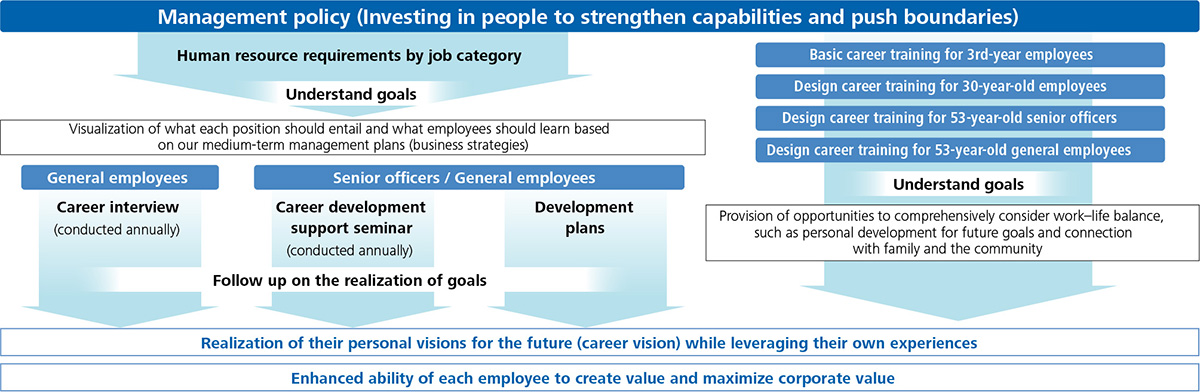
JVCKENWOOD Career Design overview
Understand goals
・Set Human Resource Requirement Levels Based on Human Resource Requirement Definitions and Execute Development Plans
In human resource requirement definitions, we have established "human resource requirement levels" by job category for all employees, as skill levels required to achieve our mid-term business plan "VISION 2025." When setting human resource requirement levels, we define the "essential" skills, experience, training, etc., by job category, thus supporting career visualization. For the execution of development plans, we have assigned a career designer (CD) in the Human Resources Department to support the development of advanced skills among employees by analyzing the gap between human resource requirement levels and the current status for each job category, preparing employee development policies, and engaging in career consultations. Employees understand the skills, experience, training, etc., required of each job category, and know the level that they are currently at. In this way, it is easier to consider their own career because they know what is necessary to learn, and what skills and knowledge to enhance to move forward in their career in the future.
Follow up on the realization of goals
・Career Interview
In career interviews, a fundamental aspect of JVCKENWOOD Career Design, employees themselves discuss their career vision (where they see themselves in the future) with their superiors, checking career development themes (matching with affiliated divisions, individual skills, etc.) with reference to human resource requirement definitions. In this way, these interviews provide an opportunity to ensure alignment between the direction individuals wish to advance in and the expectations of the Company. We also ensure alignment concerning the human resource requirement levels with the employees themselves. These meetings are for general employees and take place once a year.
・Career Development Support (Support for Taking Individual Career Development Courses)
Based on support for skill enhancement through the human resource requirement definitions and the CD, all employees can participate in training once every year in accordance with their own aims for their careers from among a selection of options, and we provide opportunities for serial learning. In this way, we support self-actualization and self-reformation.
・Career Design Training
We hold career design training for employees aged 30 and 53, two critical junctions of their career, to provide opportunities for creating their own career visions and further contemplation of what actions are necessary for realizing their career goals. By working to ensure self-directed career development for young employees of 30, we aim to encourage individual growth and enhance the ability to respond to organizational change. For senior employees of 53, we aim to inspire them to quickly develop their awareness, including the importance of reskilling when choosing reemployment and transfers, amid a social environment that requires lifelong careers. This training acts as an opportunity for participants to comprehensively think about work-life balance, such as "self-development to achieve future goals" and "connections with home life and the local community," as part of discussions about their career visions with other training participants.
The measures that supplement JVCKENWOOD Career Design
Building on JVCKENWOOD Career Design, we are working to create a human resources portfolio linked to strategic recruitment activities and business strategy. We support the career growth of each individual employee through promoting rotation - particularly of young staff - as well as seminars, workshops, and individual meetings with career designers. We provide a wide range of growth opportunities, such as training for employees at different levels - including new employee training and training for staff being promoted - new manager training, as well as external seminars and business schools, design management training, and training for senior employees. Building a broad training structure has created an environment which responds to employees' appetite for self-directed growth.
Recruitment
JVCKENWOOD is committed to the recruitment, training, and performance of diverse human resources. Recruitment of new graduates and mid-career recruits is also an important initiative in our Medium-Term Management Plan VISION 2023, which aims to restructure our workforce by age group. As part of our recruitment activities for new graduates, we offer internships in cooperation with certain specified universities and open internships. Internships are very important in recruiting new graduates because they deepen their understanding of and interest in our company through work experience, and because the ratio of job offers is high, we will continue these activities in the future.
We are also focusing on mid-career recruitment as well as new graduate recruitment. In order to maintain our company's competitiveness and productivity, we recruit mid-career our company recruits, regardless of gender or nationality, from a wide range of generations, including those in their late 20s and 30s, and utilize the expertise of individuals who have worked in different environments. In fiscal 2024, 64 mid-career employees joined the company.
Promotion, Pay and Benefits, and Evaluation Systems
As part of the JVCKENWOOD promotion system, we provide the Level Definitions to staff, which make clear the knowledge, skills, and roles required at each level. By doing so, we are working to ensure fairer evaluations, pay, and benefits regardless of age, gender, etc. In addition, the pay and benefits system includes a bonus and pay rise framework linked to both company performance and individual evaluation. Within the bounds of capital management based on company performance, this framework provides appropriate rewards to high-performing staff.
To ensure fair individual evaluation, superiors provide staff with quarterly updates about their progress towards targets, extent of their contribution, results, and a review of their work in that quarter, which they work through together. Evaluation results and reasons for them are provided together as feedback every half year. As well as being connected with pay and benefits, the evaluation system is designed to be a framework to lead to future growth.
Promotion of Diverse Work Styles
Under the policies of "VISION 2025," JVCKENWOOD will establish Value Creation Square (VCS) as a new value creation base integrating the administrative divisions and the headquarters and technical divisions to strengthen technical development and promote further work style reforms with the aim of enhancing corporate value over the medium to long term.
JVCKENWOOD will develop a diverse and flexible work environment centered on VCS to realize hybrid work that allows employees to work from any location, including telecommuting, satellite offices, and business sites. JVCKENWOOD will improve employee performance by encouraging a change in corporate culture through the activation of open communication and will also increase satisfaction with work styles. The Company also seeks to create open innovation by providing a place to promote co-creation with outside companies.
Status of Promotion of diverse work styles
| Units | FY2022 | FY2023 | FY2024 | |
|---|---|---|---|---|
| Ratio of employees who have done telework* | % | 44.3 | 42.9 | 46.2 |
| Total actual hours worked per year | hours | 1,890 | 1,873 | 1,889 |
| Ratio of days of annual paid leave obtained per employee | % | 58.2 | 72.1 | 65.5 |
| Average number of days of annual paid leave obtained per employee | days | 15.7 | 18.8 | 16.5 |
| Childcare leave and Shortened working hours for childcare and Child nursing care leave | % | 94 | 100 | 100 |
| Childcare leave | persons | 6 | 20 | 19 |
| Shortened working hours for childcare | persons | 39 | 34 | 29 |
| Child nursing care leave | persons | 44 | 60 | 52 |
| Shortened working hours for nursing care | persons | 2 | 1 | 1 |
* Telework rate, which is calculated as the non-attendance rate: total non-attendance days / (total working days × number of employees).
Development of Management Human Resources
JVCKENWOOD is implementing a focused training program to develop candidates for the next executives. Specifically, training is provided in the categories of newly appointed executive positions, newly appointed managers, and selected executive training. Through these management training programs, we are building a system for fostering management personnel over the medium to long term.
In addition, in order to develop expertise knowledge and practical knowledge required by the company as a whole for business strategies and business operations within the company, expertise knowledge and practical training are provided, which are voluntarily planned by individual divisions. The average annual training time per employee* is 25.3 hours.
* Calculations are based on the List of Training to Develop/Strengthen Skills (Table below).
Training to Develop/Strengthen Skills
Units: persons
| Training category | Content (eligible persons) | Number of Participants in FY 2024 | |
|---|---|---|---|
| Managerial-class training | Dispatch to outside training | 4 | |
| Tier-specific training | 1) New Employee Training: group training and e-learning | 47 | 194 |
| 2) Promotion Requirements Training: Training for general employee of promotion candidates | 98 | ||
| 3) New Manager Training: training for persons newly promoted to managerial positions | 49 | ||
| Career design training | Please see Career Development Program below | 140 | |
| Career development support | Please see Career Development Program below | 594 | |
| Design Management training | In order to strengthen human resource development and organizational capabilities to achieve innovation, we conduct this training to spread customer-oriented design management internally. | 217 | |
| Specialist knowledge training and practical seminars by individual organizations | Training on expertise knowledge and practical operations planned/administered by individual organizations <FY2023 Training Topics> |
- | |
Hours and costs of training to Develop/Strengthen Skills
| Units | FY2022 | FY2023 | FY2024 | |
|---|---|---|---|---|
| Total training hours | hours | 36,191 |
77,262 | 78,932 |
| Training hours per employee Hours | Hours | 11.31 | 24.44 | 25.32 |
| Total training expense | thousand yen | 79,089 | 119,158 | 161,108 |
| Investment in training cost per employee | thousand yen | 24.71 | 37.70 | 51.69 |
Other Initiatives
Fostering Female Managers
Please see the page linked below to learn about stratified training provided to female staff to foster future women executive positions.
Free Agent (FA) Program
We have introduced a free agent (FA) program to encourage self-fulfillment and self-transformation while fostering a culture of challenge. To be eligible, an employee must have worked for the company for a specified number of years and have gained commensurate work experience. Our goal is to encourage employees to willingly and independently take stock of their skills as well as experience while giving them the opportunity to reach their desired position through the rigorous selection process of the FA program. This is all in the hope that they will remain highly motivated, fully use their abilities, and make a significant contribution to our business.
Internal Recruitment Program
Similar to the FA program, the internal recruitment program allows an employee to transfer to another department within the organization based on their own will and motivation. It differs from the FA program in that, in addition to promoting organizational vitality through the continual rotation of human resources, it is also designed to quickly place people who can hit the ground running in departments that need them. This program, along with the FA program, enables employees to work independently to develop their skills while helping them achieve their individual career goals.
Initiatives to Pass on Technology and Know-How
The JVCKENWOOD Group has a re-employment program for employees who contributed to the company until they reached retirement age. The program is designed to reduce the technological impact from experienced engineers leaving the job due to retirement and to ensure that the company’s collective technology and know-how are passed on. This program, in accordance with the Act on Stabilization of Employment of Elderly Persons, allows those who have reached the prescribed retirement age of 60 to extend their employment up to age 65 if they so desire.
It benefits rehired employees in that it continues to provide them with a livelihood after they have reached retirement age while giving them sufficient time to pass on the technology and know-how they have developed over the years to the next generation.
Super Flex-Time System
JVCKENWOOD is promoting work style reforms from a variety of perspectives, such as respecting employees' diverse values, achieving work-life balance, and improving productivity. As part of this program, and with a particular aim to improve productivity, we have implemented the Super-Flextime System. Its main features are abolishing core working hour requirements, expanding flexible time, and setting non-working days. The non-working days framework allows employees to use their overtime hours to set days on which they do not work, enabling, for example, having three days off a week.
Workstyle Selection System(shorter hours/shorter weeks/area-based)
Aiming to provide work style options with more flexibility and diversity, for permanent employees JVCKENWOOD is implementing systems for selecting shorter work hours or weeks as well as an area selection system, which limits an employee's geographical work area.
*Area refers to the region in which an employee can be transferred without requiring them to move house.
Health and Welfare System
In addition to legal requirements, we provide the following health and welfare systems to support employees' lifestyles.
- Single employees' dormitories, company housing, and housing allowances
- Various allowances such as for commuting and families
- Support for asset building (preferential savings system and employee stock ownership system)
- Group insurance
- Retirement benefit system, defined-benefit pension plan, defined-contribution pension plan
- Child care and nursing care support systems, etc.


